

Article
How people in Lithuania, Ukraine, and Kazakhstan are rethinking security beyond the state, and what happens when "security" becomes a weapon.

Last year's RUTA1 panel, "Reimagining Climate Justice in Central and Eastern Europe, Central Asia, and the Caucasus," traced how layered coloniality – Soviet infrastructure, present-day Russian aggression, and Western extraction dressed as green partnership – shapes energy and climate injustice across our regions. This year's panel added another layer to that conversation: security.
A need to feel safe is universal for every human being. But on the global level, security is usually read through military and state lenses – we hold security conferences in the face of wars, and we watch politicians manipulate the feeling of safety to stay in power. This year’s panel asked what changes when we read security instead through ecosystems, communities, and care. What does "rooted knowledge" actually build, and how do we keep it from being co-opted to reinforce the same old power structures? What does security look like in relation to your native land, your neighbouring lake, or even your own wellbeing?
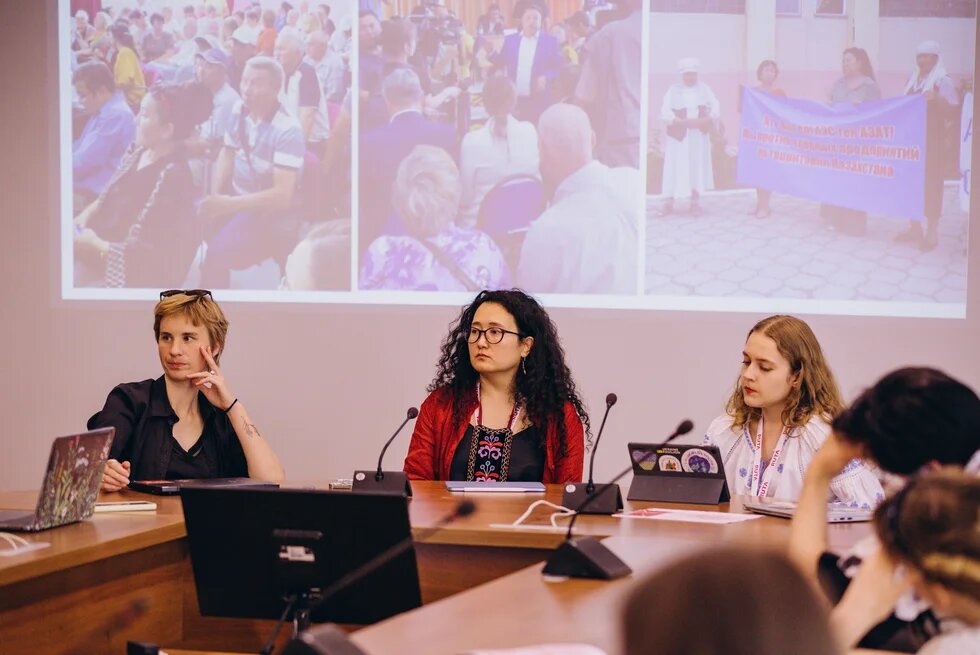
Three speakers – Živilė Mantrimaitė (Lithuania), Viktoriya Ball (Ukraine), and Aigerim Kapar (Kazakhstan) – took up that question from three different national contexts, and arrived, independently, at the same diagnosis: what gets marketed as "security" today is very often a false solution in disguise – nuclear expansion, weaponized energy rhetoric, extractive recovery models – while real security keeps turning out to be something of a smaller scale, slower, and rooted in community.
When "Energy Security" Becomes a Political Weapon
Živilė Mantrimaitė opened the panel with a warning drawn from her research with the European activist collective Gastivists: across Central and Eastern Europe, "energy security" has stopped meaning what it once did.
"The far right movements have effectively redefined the term energy security to no longer mean resilience and decentralization," she explained. "Now it means continuous supply, cheap energy, and national control – favoring nuclear and fossil fuels." A decade ago, she noted, the term pointed the other way: toward ending dependence on fossil fuels, toward decentralized systems. Now the political current is pulling it back toward the language of supply – which, in practice, means gas, oil, and nuclear.
The pull isn't invented out of nothing, she was careful to stress. High electricity prices, energy poverty, and unreliable heating are real, lived experiences across the region – and the far right is succeeding precisely because it speaks to genuine insecurity rather than manufacturing it. Fico's continued defense of Russian gas contracts, Orbán's framing of Russia as an indispensable energy partner, and the domestic fossil fuel expansion underway in Poland and Romania all differ in their specifics, but share the same underlying assumption: that security means securing supply, never asking the harder question of dependency itself.
That question of dependency, Živilė argued, doesn't disappear just because the supplier changes. Lithuania's LNG terminal freed the country from Russian pipeline gas – but new research shows its reliance on Iranian and Azerbaijani gas is generating its own instability. Replace gas with nuclear, and uranium supply chains bring new entanglements. Replace fossil fuels with renewables, and roughly 90% of the world's solar and battery supply chain runs through China. "My point is not that renewables are inherently problematic as technologies," she said, "but that the energy system currently imagined creates dependencies. The question is not whether dependencies exist, but which ones we choose to build."
Her answer pushed toward something deliberately unglamorous: small-scale, local, low-tech knowledge. With the Lithuanian Architecture Fund, she has been experimenting with solar kettles, solar showers, and a repurposed absorption refrigerator that cools using heat rather than electricity – devices modeled on how Lithuanian farmhouses once organized heat and food storage around masonry stoves, long before centralized grids existed. "None of these technologies are intended to replace national energy systems," she said, "but they remind us that energy security has not always been understood as a continuous fuel supply. The task ahead”, Zivile points out, “is to build a materially compelling, lived alternative – not just to defend decarbonization targets, but to actually bring energy security to people”.
Chornobyl’s Lessons on Wellbeing for Ukraine’s Reconstruction
Viktoriya Ball, a Ukrainian climate and health justice researcher, began by asking the room to test the standard framework for energy security – availability, accessibility, affordability, acceptability – against their own lives and electricity supply. Little to no hands went up across these categories, the least one being acceptability.
That framework, she argued, has a structural blind spot: it doesn’t ask about the cost of this energy for the health, wellbeing and environment. This is the blind spot Viktoriya uncovered in her research. She argued that energy cooperation projects between Western Europe and its former colonies – or between Russia and its former Soviet republics – are rarely mutually beneficial; they tend toward extraction. And even well-being-centered economic models popular in Western policy circles, she noted, tend to miss the household and the body: the WHO estimates that indoor air pollution from solid fuel cooking alone causes over four million premature deaths every year.
Ukraine inherited a Soviet energy model built to feed Soviet industry across the Union, not Ukrainian communities. This centralized fossil-dependent system is now a direct casualty of Russia's war. Because of regular drone and missile attacks targeted at energy infrastructure, Ukraine’s generation capacity dropped from 38 gigawatts before the full-scale invasion to just 12 gigawatts by mid-2024. Decentralization, Viktoriya said, has become a security priority in Ukraine "much more than it ever was a sustainability measure."
She grounded the argument in her own family's history. On the night of April 26, 1986, her grandmother, Lidiia Malynovska – then a newspaper editor in Chornobyl – went looking for her teenage daughter, who was out late. She tasted metal in her mouth and that evening both had started losing their voices. She recalled the head of the Chornobyl police telling the local Communist Party chief that an accident had happened at the plant; when she traveled to Moscow for answers, she was told to go home and keep publishing the newspaper. Viktoriya’s grandparents stayed in the exclusion zone for months afterward, documenting displacement and monitoring the electrical grid, not fully understanding what they were exposed to. Neighbors and coworkers were later diagnosed with leukemia; some people, forty years on, were never told their diagnosis at all. "A centralized, secrecy-dependent energy regime doesn't just create an acute disaster risk," Viktoriya said. "It creates a legacy of enduring harm that is never documented and never counted."
This legacy of the importance of oral histories and personal accounts in understanding the impact of harmful infrastructure, she argued, should shape a new framework for Ukraine's reconstruction – one built around four questions of justice: distributive (who has access to clean water, air, and uncontaminated land), procedural (who is actually consulted before infrastructure decisions are made, not after), recognition (whose needs get counted at all), and restorative (are we rebuilding health and water systems, or "just hitting the emissions targets the EU Green Deal has put forward for us as part of accession"). Applying those questions reframes decentralized renewable energy as a public health intervention rather than a purely environmental one – solar installations funded by civil society are already keeping Ukrainian hospitals' dialysis machines and asthma treatments running through air raids, in ways centralized substations, once struck, cannot.
She closed with a caution aimed at her own framework as much as anyone else's: even wellbeing-centered models can reproduce the exclusions they claim to fix. Youth, women's, and workers' movements remain largely absent from Ukraine's energy decision-making today. So, in order to shift the status quo and ensure a just reconstruction of Ukraine, we need to change who is making decisions and what metrics they are taking into account.
The Lake Balkhas’s Decades of Resistance
Aigerim Kapar closed the panel speaking, as she put it, "on behalf of the Lake Balkhash" and the Artcom Platform community with whom she works in Kazakhstan.
The proposal to build a nuclear power plant on Balkhash's shore, near the town of Ülken, is not new. It first surfaced in 1997 – was cancelled in 2000, revived in 2006 through renewed cooperation with Russia, and has resurfaced repeatedly since, each time promoted by Rosatom as a form of development. In 2019, Kazakhstan's president said any such decision would require a referendum. That referendum was finally held in 2024. Public hearings in Ülken were criticized for a lack of transparency. And in 2025 – a year after the vote billed as a democratic safeguard – Rosatom was selected as the lead partner in the international consortium chosen to build the plant, with two more now planned in the same region.
All this, as the lake itself is facing an unprecedented risk of drought, potentially following the catastrophic fate of the Aral Sea. Lake Balkhash's decline traces back to Soviet hydropower projects in the 1950s and 60s. Protest movements defending the lake in the late 1980s were interwoven with the Nevada–Semipalatinsk anti-nuclear movement – one of the region's most influential environmental justice campaigns, linking nuclear violence, public health, and ecological protection into a single struggle. Researching that history for her own graduate work, Aigerim came across The Balkhash Saga, a 1989 film documenting that mobilization – a counter-archive in its own right, built from oral testimony and community memory rather than official record, similar to the survivor testimonies Viktoriya described from Chornobyl.
"We believe the lake has agency," Aigerim said, noting that despite six decades of Soviet and now Russian ambition, the plant has never actually been built. At public hearings in Ülken in 2024, one woman told officials directly: "We're mothers, and we don't want to build this nuclear power plant. We are not afraid."
For the Kazakh people, Balkhash was never simply a resource to be allocated. Long before any hydropower station or nuclear plant was proposed, it sustained pastoralist nomadic communities and ways of life that were profoundly transformed by Soviet collectivisation, forced sedentarisation, and industrialisation. Even the region's pockets of support for the nuclear project are not really about the lake itself, Aigerim noted – some are connected to communities shaped by Soviet-era settlement and to long-standing expectations of industrial development and jobs. For local communities whose lives have long been connected to the lake, Balkhash is not simply competing with development; it simply is the thing that has always secured them – water, food, work, memory, sense of belonging – long before "energy security" became the language used to justify building over it.
Prevention, Not Just Repair
In the discussion that followed, the moderator posed a question that reframed everything said so far: why is it that people – and movements – are so much better at responding to security threats than preventing them?
Živilė's answer returned to material practice: Lithuania's own district heating system had to revert to burning decades-old, highly polluting oil when Russian gas was cut off after the full-scale invasion – a decision made with no long-term plan, replaced years later with a gas supply now destabilized by the war in Iran. "This is a continuous problem of humanity," she said. "We really just plan for the next five years." Her proposed antidote was to normalize devices and practices that visibly work – a slow, material argument rather than an abstract one about emissions.
Viktoriya pointed to what has already emerged organically in Ukraine since the full-scale invasion: neighbors in a single apartment building assessing shared risks together, solar cooperatives powering municipal buildings in Slavutych, Ukraine, as well as citizen-led documentation of pollution and health harms – such as at community health tribunals pioneered by Bangladesh health justice collectives. The task, she argued, is to stop treating these as isolated inspiring cases and start treating them as replicable evidence for long-term solutions.
Aigerim's answer was even more sobering. Central Asia, she said, already carries the memory of a stolen sea – the Aral disaster is not history but an ongoing case study whose lessons the region is still struggling to fully absorb, even as it now applies them, imperfectly, to defending Balkhash before the water runs out rather than after.
Conclusion
If there's one thing this panel makes hard to ignore, it's that anyone offering a single solution to security is lying. Security threats today are multifaceted – military, geopolitical, environmental, economic, social – and treating any one of them in isolation is itself the mistake. Energy security isn't a technical problem solved by picking the right fuel or signing the right deal; it has to be cross-sectoral, built into how health systems, cities, and ownership of resources are structured. That's a harder proposition than most policy conversations allow for, because it resists the appeal of one clean fix – a new grid, a new pipeline, a new international agreement.
Because the threats are everywhere, though, so are the solutions. Sometimes that decentralization is close to literal: a missile strike takes out a district heating plant serving an entire city at once, while small, distributed heating systems fail one household at a time rather than all together. Sometimes it's more layered. A nuclear power plant on Lake Balkhash doesn't just lock Kazakhstan into a dependency that could outlast a century of governments – it stacks that dependency on top of unresolved nuclear trauma still alive in regional memory, and on water and livelihoods communities along the shore have relied on for generations. The threat was never singular, so neither is what actually protects people from it.
The same complexity applies to the EU's own energy transition, which still leans on LNG and nuclear power even as it presents itself as the alternative to fossil dependency. The climate crisis cannot be solved by repeating old colonial patterns of extraction under a greener name – and Europe cannot decarbonize in isolation from a world it still depends on for supply. Sufficiency – actually reducing demand rather than only diversifying where supply comes from – opens onto much larger questions about how our economies are built, a conversation beyond the scope of this panel. But the underlying point holds here too: there is no single policy or reform that resolves this on its own, not for Ukraine, Kazakhstan, or Lithuania, and not for the EU either. The fight for energy justice was never something any one region could win alone.
What all three speakers demonstrated, each from a different geography and a different crisis, is that the solutions were already there before anyone went looking for them on this panel – in communities, in inherited memory, in ancestors who lived through their own versions of this same instability long before "security" became the word for it. This crisis is new to us. The pattern underneath it is not.
The opinions, conclusions and recommendations belong to the authors of this article and do not necessarily reflect the views of the Heinrich Böll Foundation in Ukraine and the German Government.